You have finally identified the process behind your expertise.
You can see the stages. You know how clients move from the problem to the result. You have turned years of instinctive knowledge into something structured.
And now you are staring at the page thinking:
What on earth do I call this thing?
Naming a signature framework can feel strangely difficult.
The process may have taken decades to develop.
The name gets three words.
No pressure.
The good news is that your framework does not need the cleverest name in your industry.
It needs a name people can understand, remember, and associate with you.
Clear beats clever.
Almost every time.
What Is a Signature Framework?
A signature framework is a named structure that organizes your expertise into a repeatable process, model, sequence, or methodology.
It helps your audience understand:
Where they are.
Where they are trying to go.
What gets in the way.
What stages matter.
How progress happens.
A framework makes your thinking easier to teach and easier to remember.
Naming it gives that thinking an identity.
Instead of saying:
“I have a process I use with clients,”
you can say:
“I use the Authority Architect Framework™.”
The name creates a handle people can use to hold onto the idea.
Why the Name Matters
A framework name can help you create consistency across your content, make your methodology easier to reference, differentiate your approach, organize a book or presentation, build tools around the process, and help people remember and recommend your work.
Over time, the name may become part of your intellectual property.
But the name cannot rescue a weak framework.
That is important.
Do not start with naming.
Start with substance.
First understand the problem, transformation, stages, and point of view.
Then name what you have built.
Step 1: Define What the Framework Does
Before brainstorming names, finish this sentence:
This framework helps [who] move from [problem] to [result].
For example:
“This framework helps experienced experts move from hidden, scattered expertise to a clear body of work that builds authority.”
Now you have useful naming material.
Key ideas might include experience, expertise, structure, authority, body of work, transformation, or architecture.
The name should connect to what the framework actually accomplishes.
Step 2: Identify the Central Metaphor
Some frameworks become easier to remember when built around a metaphor.
Common metaphor families include:
Architecture — blueprint, foundation, structure, pillars
Journey — path, roadmap, compass, stages
Growth — roots, seeds, branches, ecosystem
Navigation — map, compass, north star
Engineering — system, engine, mechanism
Transformation — bridge, shift, evolution
The metaphor should support the meaning.
For the Authority Architect Framework™, architecture works because the process is about taking raw experience and deliberately creating a structure from it.
The metaphor is not decoration.
It explains the work.
Step 3: Use Language Your Audience Understands
Your name should not require an explanation before someone understands the general territory.
Imagine your audience encountering it in a sentence:
“The _____ Framework helps consultants turn their expertise into a repeatable methodology.”
Does the name add clarity?
Or does it make the person stop and wonder what the unusual word means?
Distinctive language can be useful.
Confusing language is not positioning.
If your framework name requires a paragraph of translation every time you say it, keep working.
Step 4: Choose the Type of Name
There are several common approaches.
Outcome-Based Names
These emphasize the result.
Examples might include:
The Authority Growth Framework
The Client Clarity Method
The Visibility-to-Authority System
Process-Based Names
These emphasize how the work happens.
Examples:
The Three-Stage Alignment Process
The Authority Architecture Method
The Expert Positioning System
Metaphor-Based Names
These use an image that represents the transformation.
Examples:
The Compass Framework
The Bridge Method
The Blueprint System
Acronym-Based Names
These use first letters from the stages.
Acronyms can work beautifully when they are natural.
They can also create frameworks that appear to have been assembled by wrestling six unrelated verbs into submission.
Do not force it.
Proprietary Concept Names
These create distinctive language around the problem or process.
Examples might include:
Familiarity Blindness
Authority Skeleton
Possibility Mapping
These can become powerful because they give a name to something the audience recognizes but may never have been able to articulate.
Step 5: Name the Stages Clearly
The framework name matters.
The stage names matter too.
Each stage should answer:
What is happening here?
Strong stage names tend to be short, active, distinct, sequential, and easy to explain.
The Authority Architect Framework™ uses:
See. Believe. Clarify. Build. Share. Inspire. Multiply.
Each word describes an action or shift.
The sequence also tells a story.
First you see your value.
Then believe it matters.
Clarify the message.
Build the body of work.
Share it.
Inspire change.
Multiply the impact.
You can understand the broad journey even before receiving the complete explanation.
That is the goal.
Step 6: Make Sure the First and Last Stages Are Strong
Your first stage tells people where the journey begins.
Your final stage shows what becomes possible.
If those are vague, the framework may feel incomplete.
Ask:
What must happen before anything else works?
That may be your first stage.
Then ask:
What does success create beyond the immediate result?
That may reveal your final stage.
The last stage does not always mean “finished.”
Often it represents continuation, growth, expansion, application, or multiplication.
Step 7: Say the Name Out Loud
Framework names live in conversation.
Test yours in sentences:
“I created the ______ Framework.”
“I teach the ______ Method.”
“The first stage of the ______ System is…”
“In my book I explain the ______ Framework.”
Would you feel comfortable saying it on a podcast?
Can someone hear it once and repeat it?
Does it sound like you?
Names that look wonderful on a whiteboard sometimes become surprisingly awkward once introduced to actual oxygen.
Say it aloud.
Step 8: Test It With Real People
Before building an entire brand around the name, show it to several people who resemble your audience.
Ask:
What do you think this framework is about?
What does the name make you expect?
Which part is memorable?
Is anything confusing?
Do not explain it first.
Their initial interpretation is valuable.
If everyone guesses something completely unrelated to your work, that is useful information.
Step 9: Check Availability
Once you have a serious candidate, do some basic due diligence.
Search the phrase online.
Look at competing businesses and programs.
Check relevant domain and social usage.
You want to know whether the name is already strongly associated with someone else's work.
If the framework will become a significant commercial asset, you may also want to speak with an intellectual-property attorney about trademark availability and protection.
A creative name does not automatically mean you have exclusive rights to use it.
That is a legal question, not a branding assumption.
Step 10: Build Consistency Around the Name
Once you choose the name, use it.
Consistently.
Use the same terminology across your website, articles, book, presentations, worksheets, assessments, podcast interviews, programs, and social content.
People cannot associate a framework with you if you rename it every three months because Tuesday's version suddenly sounded more exciting.
Consistency creates memory.
Should You Trademark Your Framework?
Possibly.
Trademark protection depends on several factors beyond whether you like the name.
An intellectual-property attorney can help determine whether the name may be protectable, whether similar marks already exist, what categories may apply, and how it should be used.
The strategic question is simpler:
Is this framework becoming an important identifiable asset in my business?
If yes, it may be worth investigating appropriate protection.
Can AI Help Name a Framework?
Absolutely.
AI can be useful for brainstorming metaphors, word combinations, naming categories, synonyms, acronym possibilities, and variations.
But do not simply ask:
“Give me a brilliant framework name.”
And choose option four.
Give the AI context.
Explain who the framework helps.
The transformation.
Your point of view.
The stages.
Your brand language.
Words you like.
Words you never want to use.
Then use the suggestions as raw material.
AI can accelerate brainstorming.
You still decide what deserves your name.
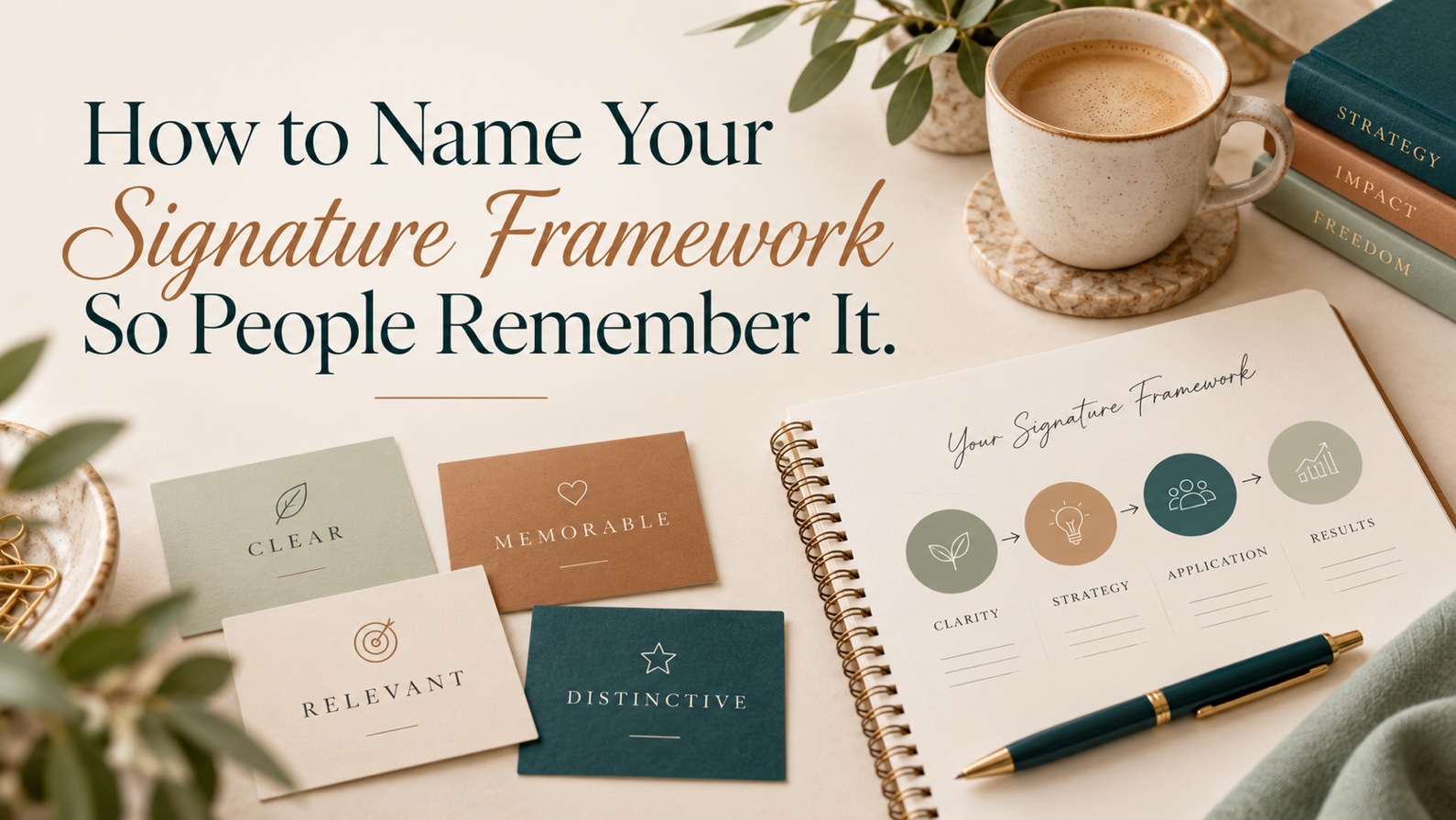
A Good Framework Name Should Pass Five Tests
Before deciding, ask:
Is it clear?
Can someone understand the general territory?
Is it memorable?
Can they recall it later?
Is it relevant?
Does it connect to the actual transformation?
Is it distinctive?
Does it feel connected to your body of work rather than generic industry language?
Is it expandable?
Could the framework support a book, presentation, assessment, workshop, or future program?
You do not need perfection.
You need a strong enough container for the thinking.
Your Next Inspired Action
Take your framework and create five columns:
Transformation
Audience
Metaphor
Outcome
Key Language
Fill each column with ten words or phrases.
Then begin combining them.
Do not evaluate too quickly.
Generate possibilities first.
Narrow them later.
And remember:
The framework itself carries the value.
The name helps people find and remember it.
Build the Framework Before You Brand It
If you are still trying to uncover the methodology inside your experience, join me for my next free Authority Architect Framework™ presentation.
We will walk through:
See. Believe. Clarify. Build. Share. Inspire. Multiply.
You will learn how experience becomes a body of work—and where a signature framework fits in that journey.
Register for the free live presentation:
https://donnaamos.com/free-live-presentation/
Give your expertise structure first.
Then give that structure a name worth remembering.