
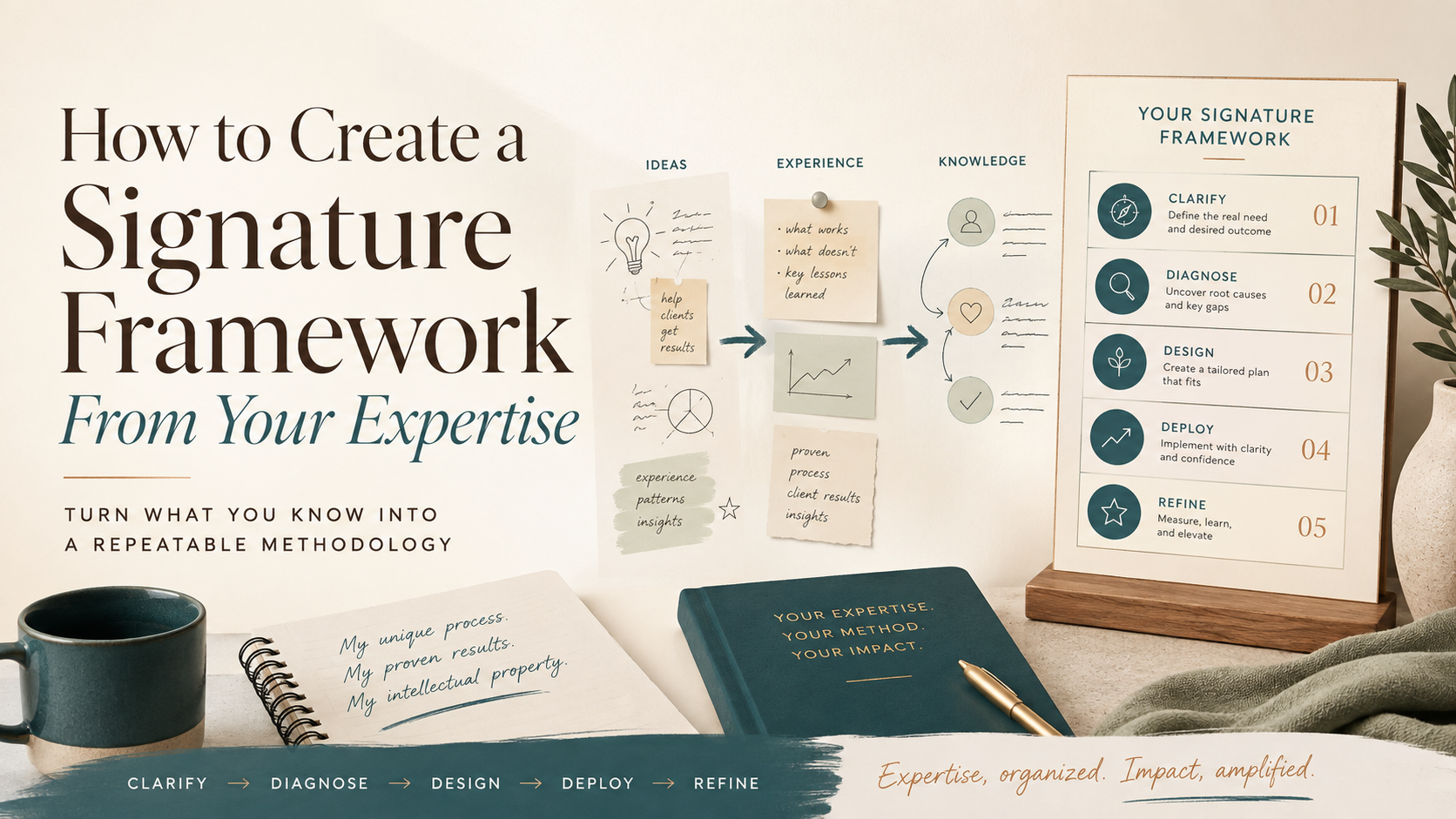
You probably already have a framework.
You just may not recognize it yet.
If you have spent years solving the same kinds of problems, advising clients, answering similar questions, or guiding people toward a particular result, there is likely a pattern behind the way you work.
You may call it experience.
Your clients may call it expertise.
But when that knowledge is organized into a clear, repeatable process, it can become something even more valuable:
A signature framework.
A signature framework takes the knowledge you have accumulated over years and turns it into a methodology other people can understand, remember, and use.
It helps answer questions such as:
- What do you actually do differently?
- How do you help people move from problem to result?
- What do you believe about the problem that others may overlook?
- What steps consistently create progress?
- Why should someone remember your approach?
For consultants, coaches, authors, speakers, and experienced professionals, a strong signature framework can become the foundation of an entire body of work.
It can support your book.
Your keynote.
Your workshops.
Your content.
Your consulting process.
Your course.
Your thought leadership.
And perhaps most importantly, it can help other people understand the expertise you may have been carrying around in your head for years.
What Is a Signature Framework?
A signature framework is a named, repeatable methodology that organizes your expertise into a clear process people can understand, remember, and apply.
It is not simply a list of tips.
And it is not a clever acronym you created because the letters happened to cooperate.
A useful framework explains how transformation happens.
It usually shows:
Where someone starts.
Why they are stuck.
What needs to change.
The stages or principles that create progress.
Where the process ultimately leads.
A framework gives your expertise architecture.
Instead of saying:
“I help people with leadership.”
you can explain:
“I help leaders move through these four stages.”
Instead of:
“I help consultants build authority.”
you can show the process behind that transformation.
That difference matters.
When people understand your process, they begin to understand how you think.
And when they understand how you think, trust becomes easier to build.
Why Experienced Experts Often Struggle to Create a Framework
One of the biggest obstacles is something I see repeatedly:
Your expertise has become too familiar to you.
You have performed certain tasks so many times that you no longer notice the decisions you are making.
You may immediately recognize the problem a client is facing.
You know which question to ask next.
You know what usually goes wrong.
You know which step cannot be skipped.
You know when someone is trying to solve the wrong problem.
But because those judgments have become natural, you may assume there is nothing special about them.
That is exactly why creating a framework can be difficult.
You are attempting to examine consciously something you have learned to do instinctively.
The work is not always inventing a new methodology.
Often, it is uncovering the methodology that already exists inside your experience.
Why a Signature Framework Builds Authority
Authority does not come from telling people you are an expert.
It grows when people repeatedly experience evidence that you understand something deeply.
A signature framework helps demonstrate that depth.
It shows that you have moved beyond individual tactics and can see patterns.
That matters because experts think in patterns.
After enough years doing the work, you begin recognizing:
- Recurring problems
- Predictable mistakes
- Common turning points
- Repeated questions
- Important sequences
- Principles that consistently produce better outcomes
Your framework makes those patterns visible.
It also gives people language they can associate with you.
That is an important part of thought leadership.
You do not simply want people to remember that you gave them useful advice.
You want them to remember the idea behind the advice.
Step 1: Start With the Transformation
Before naming anything, begin with the change you help create.
Ask:
Where is someone before they encounter my work?
And:
Where are they afterward?
Be specific.
For example, suppose you work with experienced consultants.
The starting point might be:
They have years of experience but cannot explain what makes their approach different.
The ending point might be:
They have a clear positioning statement, proprietary methodology, and body of work that makes their expertise easier to understand and trust.
Now you have the boundaries of the framework.
Your framework exists to explain the journey between those two points.
Try this:
Complete these two sentences:
My audience begins with:
I help them move toward:
Do not worry about making the language elegant yet.
Clarity first.
Naming comes later.
Step 2: Study the People You Have Already Helped
Your past clients, customers, students, or experiences contain clues to your methodology.
Choose approximately five to ten examples of people you have helped.
For each one, ask:
- What problem did they initially bring to me?
- What was actually keeping them stuck?
- What did we address first?
- What changed next?
- Was there a moment when progress accelerated?
- Which part of my approach mattered most?
- What mistakes did I repeatedly help them avoid?
- What sequence seemed to work best?
Then look across all the examples.
What repeats?
Those repetitions are extremely important.
For example, you may notice that before clients can develop a strategy, they always need clarity.
Or before they can communicate confidently, they first need to believe their experience has value.
Or before they can scale a service, they need to turn an informal process into something repeatable.
That repeated sequence is where your framework begins taking shape.
Step 3: Identify the Stages
Now write down the major stages someone moves through.
Most frameworks work well with roughly three to seven stages.
Too few and the process may feel overly simplistic.
Too many and your audience may need a laminated reference card just to remember what happens next.
Each stage should represent a meaningful shift.
Ask:
What must become true before the person can move to the next stage?
That question helps prevent you from simply listing activities.
For example, my Authority Architect Framework™ follows seven stages:
See. Believe. Clarify. Build. Share. Inspire. Multiply.
Each stage answers a different question.
See
Can you recognize the value of the experience you already have?
Believe
Do you believe that experience is worth sharing?
Clarify
Can you identify what you want to be known for?
Build
Can you turn your knowledge into a body of work?
Share
Can the right people discover your ideas?
Inspire
Does your work help people think or act differently?
Multiply
Can your ideas reach farther than you can carry them personally?
The stages are connected.
One leads naturally to the next.
That is what makes the framework more than a list.
It becomes a journey.
Step 4: Identify What You Believe
A strong signature framework does more than describe your process.
It should also reveal your point of view.
Ask yourself:
What do I believe about this problem that shapes the way I solve it?
This is often where a framework becomes truly distinctive.
For example:
You might believe that people do not have a content problem. They have a clarity problem.
You might believe that leadership problems usually begin before the team ever sees them.
You might believe that a business book should not simply inform—it should organize the author’s intellectual property.
You might believe that expertise becomes more valuable when it becomes useful to someone else.
Those beliefs shape the framework.
They explain why you use a particular process.
And that “why” is often far more memorable than another collection of steps.
Try completing this statement:
Most people believe __________, but my experience has taught me __________.
There may be a very important idea hiding inside your answer.
Step 5: Turn the Stages Into Clear Language
Once you understand the stages, give each one a clear name.
The best names are usually:
- Short
- Specific
- Easy to remember
- Connected to the transformation
- Consistent with your point of view
One-word stage names can work particularly well.
For example:
Discover → Design → Deliver
or:
Assess → Align → Activate
But do not sacrifice clarity just to create alliteration.
The goal is not to win a naming contest.
The goal is for your client or reader to say:
“I know exactly where I am in this process.”
That is a powerful test of a framework.
Step 6: Give the Framework a Name
Now step back and name the entire methodology.
A signature framework name should ideally communicate either:
- The transformation
- The process
- The metaphor behind your approach
- The result
- The central concept
Common naming structures include:
The [Outcome] Framework
The [Concept] Method
The [Metaphor] System
The [Transformation] Process
The [Number]-Stage Framework
For example:
The Authority Architect Framework™
The name works because the metaphor reflects the process.
Architecture suggests structure.
An architect does not begin by choosing throw pillows.
The architect first understands the purpose, develops the design, creates the structure, and then builds something that can endure.
That metaphor reflects the work of turning expertise into a body of work.
Step 7: Make Each Stage Useful
A framework becomes valuable when people can do something with it.
For every stage, define:
The problem
What is happening here?
The question
What must the person understand or answer?
The action
What should they do?
The outcome
What changes when they complete this stage?
For example:
Clarify
Problem:
The expert knows many things but has no central message.
Question:
What do I want to become known for?
Action:
Identify the audience, problem, transformation, and point of view.
Outcome:
A clear authority positioning statement.
Now the framework can be taught.
That is where your knowledge starts becoming intellectual property.
Step 8: Build Tools Around the Framework
Your framework can become much more useful when each stage has supporting tools.
These might include:
- Worksheets
- Assessments
- Checklists
- Questions
- Scorecards
- Templates
- Diagrams
- Exercises
- Case studies
- Examples
This is one reason a signature framework can become such a powerful business asset.
The framework itself becomes the organizing structure.
Then everything else fits underneath it.
For the Authority Architect work, for example:
The Hidden Gifts Quiz helps someone identify where they may be stuck.
The Authority Architecture™ Blueprint helps them think through the stages.
The Authority Book Sprint™ helps turn expertise into one specific authority asset.
The book, presentations, articles, and future programs can all connect back to the same central methodology.
Instead of building disconnected products, you create a body of work.
Step 9: Test the Framework With Real People
Do not fall in love with your framework so deeply that you never allow another human being to look at it.
Explain it to:
- A current client
- A former client
- A colleague
- Someone in your ideal audience
Then ask:
Which stage immediately made sense?
Where did you become confused?
Could you identify where you are in the process?
Which part felt most useful?
Could you explain the framework back to me?
That last question is especially important.
If someone can understand your framework well enough to explain it to someone else, you are onto something.
If they need a forty-five-minute orientation meeting and three diagrams, simplify.
Step 10: Use the Framework Everywhere
Once you have a strong framework, stop hiding it.
Use it consistently.
Your framework can shape:
Your website
Explain your methodology and how you help clients.
Your content
Write articles around individual stages and problems.
Your book
Use the framework as the organizational architecture.
Your presentations
Teach the process visually.
Your sales conversations
Use it to diagnose where a prospect is stuck.
Your workshops
Help participants apply each stage.
Your podcast appearances
Explain one or two core principles.
Your intellectual property
Build tools, assessments, programs, and resources around it.
This consistency is important.
The goal is for people to begin associating the framework with you.
A Signature Framework Is Not About Making Yourself Look Important
This is worth saying clearly.
Creating a proprietary methodology is not about taking common sense, slapping a trademark symbol beside it, and announcing that you have discovered gravity.
Your framework should earn its existence.
It should reflect:
- Genuine experience
- Real pattern recognition
- A useful process
- A distinct perspective
- Something that makes the problem easier to understand or solve
The purpose is usefulness.
A good framework helps someone think more clearly.
A great framework helps them act more effectively.
And over time, a useful framework can also become one of the strongest foundations of your authority.
Your Framework May Already Be Hiding in Plain Sight
If you have spent years helping people solve a particular problem, you probably do not need to invent your expertise.
You need to examine it.
Look at the questions you ask.
The sequence you follow.
The mistakes you recognize.
The lessons you repeat.
The beliefs you have developed.
The results you help create.
Then ask:
What pattern connects all of this?
That pattern may be the beginning of your signature framework.
And once you give your expertise structure, something interesting happens.
It becomes easier to explain.
Easier to teach.
Easier to remember.
Easier to write about.
Easier to share.
And ultimately, easier for other people to use.
That is when expertise begins becoming something larger than experience.
It becomes a body of work.
Your Next Inspired Action
Take fifteen minutes and complete these five statements:
The people I help are:
They usually come to me because:
What I see that they often do not is:
The stages I consistently help them move through are:
The result on the other side is:
Do not worry about naming the framework today.
First, find the pattern.
The name can come later.
Are You Hiding the Gift You Were Meant to Share?
Sometimes the hardest part of building authority is recognizing the expertise you already have.
The Hidden Gifts Quiz can help you identify where you are in the Authority Architect journey—and what may be keeping you from sharing your knowledge more fully.
Take the Hidden Gifts Quiz → HERE
Your expertise has already been earned.
Now give it a structure people can understand, remember, and use.