
For years, the internet has made authority look like a popularity contest.
More followers.
More posts.
More views.
More appearances.
More noise.
And certainly, visibility matters.
People cannot benefit from ideas they never encounter.
But visibility and authority are not the same thing.
You can be visible without being trusted.
You can have a large audience without having a clear point of view.
You can publish constantly without building a meaningful body of work.
Real authority is different.
Authority is not something you claim. It is something you build.
And it is built one useful idea at a time.
What Does Authority Actually Mean?
When I talk about authority, I am not talking about celebrity.
I am talking about becoming known, remembered, and trusted for something meaningful.
When someone encounters your name, they understand:
What you care about.
What you understand deeply.
What problem you help solve.
What you believe.
How you think.
Why your perspective may help them.
That kind of authority does not require millions of followers.
Sometimes it requires exactly the right hundred people.
Authority is less about audience size and more about clarity, usefulness, consistency, and trust.
The Authority Journey Begins Before Anyone Notices
Many people believe authority begins when someone else recognizes their expertise.
I believe it starts much earlier.
It starts when you recognize it.
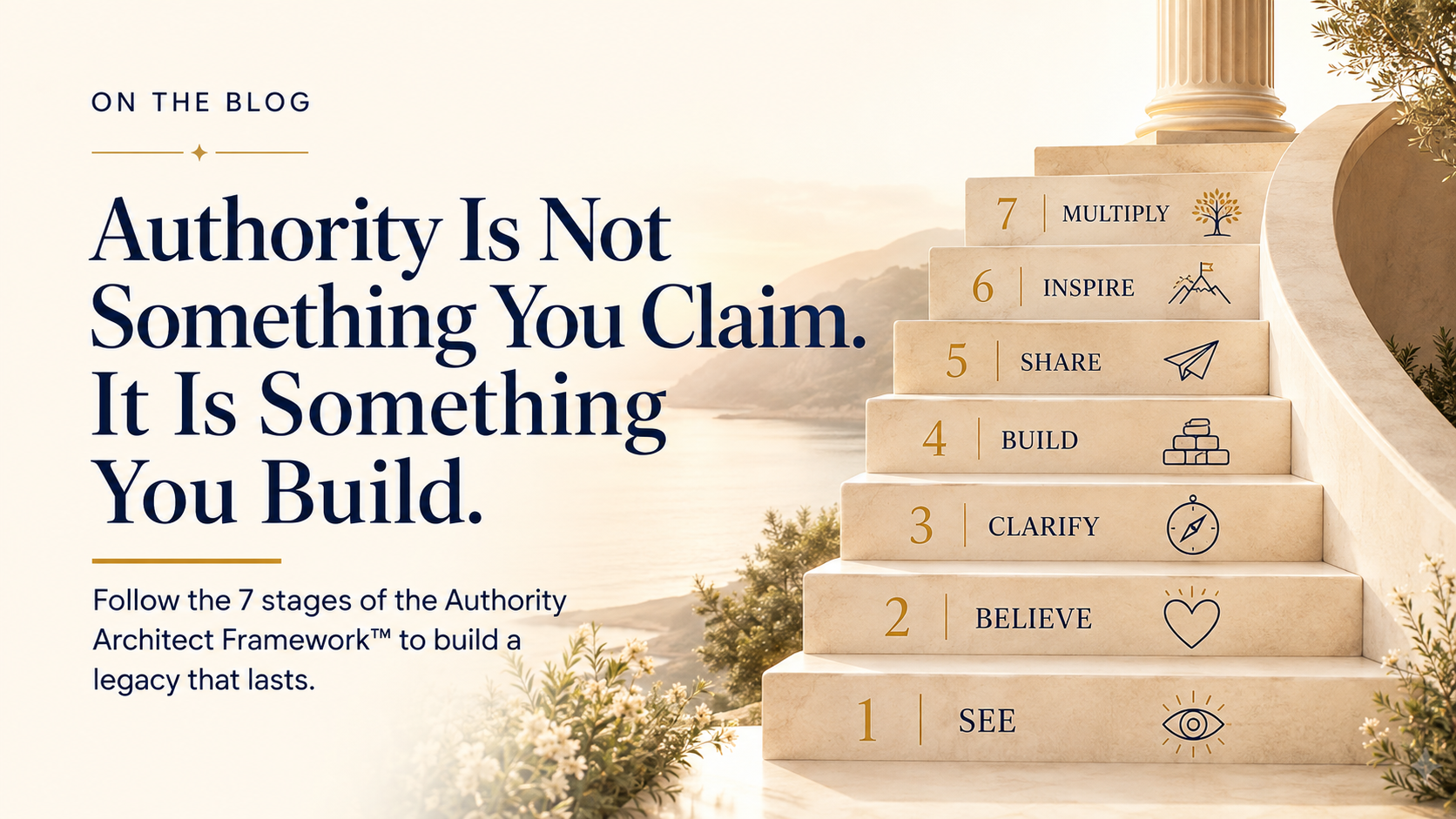
That idea led to the development of the Authority Architect Framework™, a seven-stage journey for turning experience into a meaningful body of work.
See. Believe. Clarify. Build. Share. Inspire. Multiply.
Each stage answers a different question.
1. See
What have I already earned?
Before building authority, you must recognize the experience you already carry.
Your lessons.
Stories.
Skills.
Mistakes.
Patterns.
Results.
Observations.
Processes.
The things you know so well you no longer recognize them as expertise.
This is often harder than it sounds.
Experienced people have a remarkable ability to dismiss twenty years of knowledge with:
“Oh, that’s just something I know.”
Exactly.
That is why we need to look at it.
2. Believe
Do I believe what I know is worth sharing?
Seeing your experience is not enough.
You also have to believe it can be useful.
This is where many experts stop.
They think:
Someone else knows more.
Everything has already been said.
I need another credential.
I need more confidence.
I will start when I feel ready.
Confidence rarely arrives first.
Action usually does.
Believe does not mean convincing yourself that you are the world’s greatest authority.
It means accepting that your experience may help someone.
That is enough.
3. Clarify
What do I want to be known for?
You may know many things.
Authority requires deciding which idea should become central.
Who are you best equipped to help?
What problem do you understand deeply?
What transformation can you help create?
What do you believe that shapes how you approach the problem?
When the right people hear your name, what do you want them to associate with you?
Clarity gives your expertise direction.
4. Build
What structure will carry the idea?
Now your knowledge needs architecture.
This is where expertise becomes a body of work.
You may develop:
A proprietary framework.
A nonfiction book.
A keynote.
A workshop.
A course.
An assessment.
A newsletter.
A consulting methodology.
The goal is not to build all of them at once.
That path generally ends with seventeen open browser tabs and a mild identity crisis.
Choose the authority asset that best communicates your central idea.
Build that first.
5. Share
How will people discover it?
Creating something valuable is not enough.
It has to leave the building.
Share your ideas through:
Writing.
Speaking.
Teaching.
Video.
Podcast interviews.
Newsletters.
Workshops.
Strategic conversations.
Partnerships.
You do not have to be everywhere.
You need to be consistently present where the right people are paying attention.
6. Inspire
What changes because someone experienced my work?
Authority without impact becomes an exercise in personal branding.
The purpose is not simply to be known.
It is to help.
Your ideas should help someone:
Understand.
Believe.
Decide.
Act.
Change.
See possibility.
A useful question to ask is:
What do I want someone to think, believe, or do differently after experiencing my work?
That is where information becomes transformation.
7. Multiply
How can the idea travel farther than I can carry it personally?
Eventually, your body of work should become bigger than individual conversations.
A book can become a keynote.
A keynote can become a workshop.
A workshop can become a course.
A framework can become a methodology.
A methodology can become a community.
A body of work can become a legacy.
Multiplication is not about creating more for the sake of more.
It is about allowing a valuable idea to take different forms so it can reach the people who need it.
Authority Is Built Through Contribution
This entire framework comes back to one idea.
Your authority is not about you being impressive.
It is about your knowledge becoming useful.
Authority grows when people encounter your work and think:
“She understands this.”
“This helped me.”
“I see the problem differently now.”
“I know what to do next.”
“I need to share this with someone.”
That is meaningful authority.
You Already Have the Raw Material
If you have spent years doing meaningful work, you probably do not need more raw material.
You need to recognize what you have.
Believe it matters.
Clarify the idea.
Give it structure.
Put it into the world.
Help people through it.
Then allow it to grow.
That is the work of an Authority Architect.
And it begins with one simple question:
What are you carrying that the world cannot benefit from until you choose to share it?
Are you hiding the gift you were meant to share?
Discover where you are in the Authority Architect journey and identify the next step toward turning your experience into meaningful authority.