
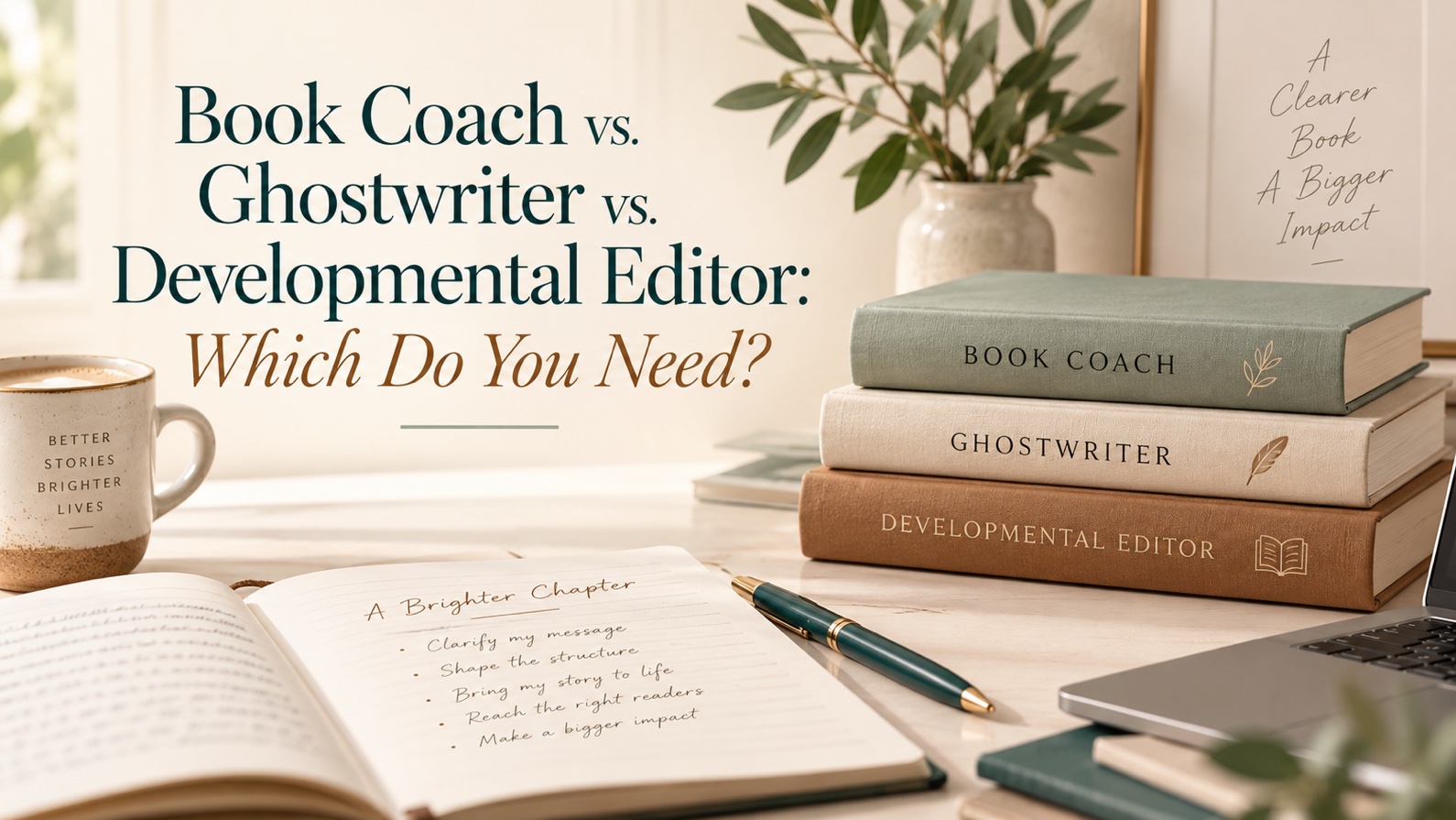
You have decided to write a nonfiction book.
Excellent.
Then you start researching help and discover an entirely new vocabulary.
Book coach.
Ghostwriter.
Developmental editor.
Copy editor.
Publisher.
Suddenly writing the book seems like the easy part.
The truth is that these professionals solve different problems.
Choosing the right support depends primarily on two questions:
Where are you in the process?
And:
How much of the book do you want to create yourself?
Let’s make the distinctions clearer.
The Simple Difference
At the broadest level:
A book coach helps you develop and write your book.
A ghostwriter writes the manuscript using your ideas, experience, interviews, and source material.
A developmental editor helps strengthen the structure and substance of a manuscript that already exists.
There can be overlap between these roles, and individual service providers structure their work differently.
But those distinctions will get you surprisingly far.
What Does a Nonfiction Book Coach Do?
A nonfiction book coach typically works with you before and during the writing process.
They may help you:
Clarify the reader.
Define the book’s purpose.
Identify the transformation.
Develop the central idea.
Create the structure.
Build the chapter outline.
Stay accountable.
Work through writing problems.
Strengthen individual chapters.
Maintain consistency.
A coach does not normally write the entire book for you.
You remain the primary writer.
Think of a book coach as someone helping you build the architecture while teaching and guiding you through construction.
A Book Coach May Be Right for You If:
You want to write the book yourself but need help creating clarity and structure.
You keep starting and stopping.
You want feedback while you write.
You need accountability.
You want to become a stronger writer.
You have enough time to participate actively in the process.
For experienced experts, coaching can be especially valuable because the problem is often not a lack of knowledge.
It is having too much knowledge and not knowing what belongs in this particular book.
What Does a Ghostwriter Do?
A ghostwriter does the writing.
Typically, the author provides the expertise through interviews, notes, recordings, presentations, research, existing content, stories, and documents.
The ghostwriter then turns that material into a manuscript designed to reflect the author's intended voice, message, and ideas.
Depending on the agreement, the author's name generally appears as the author of the book.
A Ghostwriter May Be Right for You If:
You have strong expertise but very limited writing time.
You communicate more naturally through conversation than writing.
You want someone else to handle much of the drafting.
You have substantial source material or are willing to participate in interviews.
You have the budget for professional ghostwriting.
You are prepared to review and approve the manuscript carefully.
Hiring a ghostwriter does not mean handing someone a topic and disappearing until publication day.
The strongest projects still require significant author involvement.
The writer needs access to your thinking.
Otherwise, they may write a competent book about a subject.
But not necessarily your book.
What Does a Developmental Editor Do?
A developmental editor typically works once a manuscript—or a substantial portion of one—already exists.
Their concern is the big picture.
They may evaluate:
Book structure.
Chapter order.
Argument.
Reader journey.
Repetition.
Missing information.
Pacing.
Examples.
Stories.
Transitions.
Framework consistency.
Whether the book actually delivers its promise.
This is very different from proofreading.
Developmental editing asks:
Does this book work?
Copyediting asks questions closer to:
Are the sentences correct, clear, and consistent?
Both matter.
They work at different levels.
A Developmental Editor May Be Right for You If:
You already have a draft.
You know something is not working but cannot identify what.
The manuscript feels repetitive or scattered.
The chapters do not build logically.
Your point of view gets lost.
The framework is unclear.
The reader transformation does not feel strong enough.
A good developmental editor can help turn a collection of chapters into a cohesive book.
What About a Copy Editor?
A copy editor works closer to the sentence level.
They may review:
Grammar.
Punctuation.
Usage.
Consistency.
Clarity.
Style.
Word choice.
Formatting conventions.
A developmental editor may tell you that Chapter Seven should move to Chapter Four.
A copy editor may help ensure the sentences inside Chapter Seven are clear and consistent.
These are different jobs.
And What Does a Proofreader Do?
Proofreading is usually one of the final editorial stages.
The focus is on catching remaining errors before publication.
That may include:
Typos.
Punctuation mistakes.
Formatting inconsistencies.
Spacing errors.
Page-number problems.
Small layout issues.
Proofreading is important.
But hiring a proofreader when the book has major structural problems is a little like polishing the doorknobs while the second floor is still leaning.
The sequence matters.
What About a Publisher?
A publisher has another role.
Depending on the publishing model, that may include:
Editorial coordination.
Cover and interior design.
ISBNs and metadata.
Production.
Distribution.
Publishing-platform setup.
Proofing.
Launch support.
Marketing guidance.
Traditional, hybrid, assisted self-publishing, and independent publishing models all work differently.
That is why you should understand exactly what a publisher includes before signing an agreement.
“Publishing” can mean very different things depending on who is using the word.
The Real Question: What Problem Are You Trying to Solve?
Instead of beginning with:
Should I hire a coach or ghostwriter?
Begin with:
What is stopping this book from existing?
If the problem is clarity…
You may need strategic book development or coaching before writing.
If the problem is structure…
A book coach or developmental specialist may help.
If the problem is time to draft…
A ghostwriter may make sense.
If the manuscript exists but feels weak…
You may need developmental editing.
If the manuscript is strong but unpublished…
You need publishing support.
Identifying the actual bottleneck can save an enormous amount of money and frustration.
Authority Books Need Something Before Any of These Services
There is another issue I believe experienced experts should address first.
Before choosing how the book will be written, clarify what authority the book is meant to express.
Ask:
Who is the reader?
What problem do I understand deeply?
What do I want to become known for?
What do I believe about the problem?
What framework organizes my thinking?
What transformation should the reader experience?
Without those answers, you can hire an excellent writer and still end up with a beautifully written book that does not strengthen your authority.
Good prose cannot substitute for unclear thinking.
Why I Recommend Architecture Before Manuscript
I have said this often:
Do not organize your manuscript until you organize your thinking.
For an authority-building book, the architecture may include:
The reader.
The problem.
The point of view.
The framework.
The transformation.
The supporting stories.
The evidence.
The reader's next step.
Once those pieces are clear, you can decide the best way to turn them into a manuscript.
That may involve a coach.
A ghostwriter.
An editor.
AI-assisted drafting.
A guided interview process.
Or a combination.
The tool comes after the thinking.
Where AI Fits
AI has created another option in the book-development process.
It can help transcribe interviews, organize source material, compare possible structures, generate questions, summarize existing notes, create working drafts, identify repetition, and support revision.
But the same rule applies.
AI should help express expertise.
It should not invent the authority behind it.
Whether you work with AI, a ghostwriter, a book coach, or all three, the book still needs:
Your experience.
Your judgment.
Your stories.
Your methodology.
Your point of view.
Otherwise, you are simply producing words.
Which Option Gives You the Most Authentic Voice?
This question matters particularly for authority books.
If readers will eventually hear you speak, attend your workshops, work with you, listen to your podcast, or follow your newsletter, the thinking and voice in the book should feel connected to the person they encounter elsewhere.
That does not mean you must personally type every sentence.
It means you need to remain deeply involved in the substance.
A skilled ghostwriter can capture a client's voice remarkably well.
A skilled coach can help an author find and strengthen their own.
A skilled developmental editor can preserve the author's voice while improving the book around it.
The right choice depends on your goals.
Can You Use More Than One?
Absolutely.
A common process might look like:
Book strategist or coach → Draft → Developmental editor → Copy editor → Proofreader → Publisher
A ghostwritten book might look like:
Book strategy → Interviews and source gathering → Ghostwriter → Author review → Developmental/editorial review → Copyediting → Publishing
There is no single mandatory sequence.
The key is knowing what each person is responsible for.
Questions to Ask Before Hiring Anyone
Ask prospective partners:
What exactly is included?
Who develops the book strategy?
Who creates the outline?
Who writes the words?
How many revisions are included?
Who owns the manuscript and associated rights?
How do you preserve my voice?
Is editing included? If so, what kind?
What happens after the manuscript is finished?
Do you provide publishing support?
What additional costs should I expect?
Get the details in writing.
The phrase “book package” can cover a surprising amount of territory.
A Quick Decision Guide
Choose a Book Coach When:
You want to write the book yourself and need clarity, structure, feedback, and accountability.
Choose a Ghostwriter When:
You have the expertise and budget but want a professional writer to handle much of the drafting with you.
Choose a Developmental Editor When:
You already have a substantial manuscript and need help strengthening the big-picture structure and reader experience.
Choose Publishing Support When:
The manuscript is ready and you need help turning it into a professionally produced and distributed book.
And remember:
You may need more than one.
Where the Authority Architect Framework™ Fits
An authority book does not begin at the writing stage.
See
Identify the expertise and experience worth preserving.
Believe
Recognize that your knowledge can help someone.
Clarify
Determine the reader, problem, point of view, and transformation.
Build
Create the framework and book.
Share
Put the finished work where the right people can discover it.
Inspire
Help readers apply what they have learned.
Multiply
Turn the intellectual property into presentations, workshops, programs, content, and other opportunities.
Choosing a coach, ghostwriter, or editor is a Build-stage decision.
Do not skip the work that comes before it.
Your Next Inspired Action
Before contacting a book professional, answer:
What stage is my book currently in?
What is actually preventing me from moving forward?
Do I want to write the manuscript myself?
How involved do I want to be?
What role should this book play in my larger body of work?
Those answers will make the choice much clearer.
Before You Hire Help, Understand What You’re Building
If you are considering an authority book but are still clarifying the expertise, framework, or body of work behind it, join my next free live presentation of the Authority Architect Framework™.
We will walk through:
See. Believe. Clarify. Build. Share. Inspire. Multiply.
You will see where a book fits—and whether it should even be your next authority asset.
Register for the free live presentation:
https://donnaamos.com/free-live-presentation/
The right professional can help you build the book.
But first, make sure you know what the book is meant to build.