You probably do not need more ideas.
You may not even need more content.
What you may need is a way to connect the ideas you already have.
After working with experts, entrepreneurs, authors, coaches, and consultants for years, I have noticed something interesting.
Experienced people often have an enormous amount of material.
They have:
Articles.
Presentations.
Stories.
Client conversations.
Processes.
Workshops.
Podcasts.
Notes.
Half-written books.
Training materials.
Social posts.
Ideas scribbled on legal pads, tucked into notebooks, saved in Google Docs, and occasionally hiding in folders named something reassuringly specific like FINAL VERSION 7.
The problem is rarely a shortage of knowledge.
The problem is that all of that knowledge lives in separate places.
Nothing holds it together.
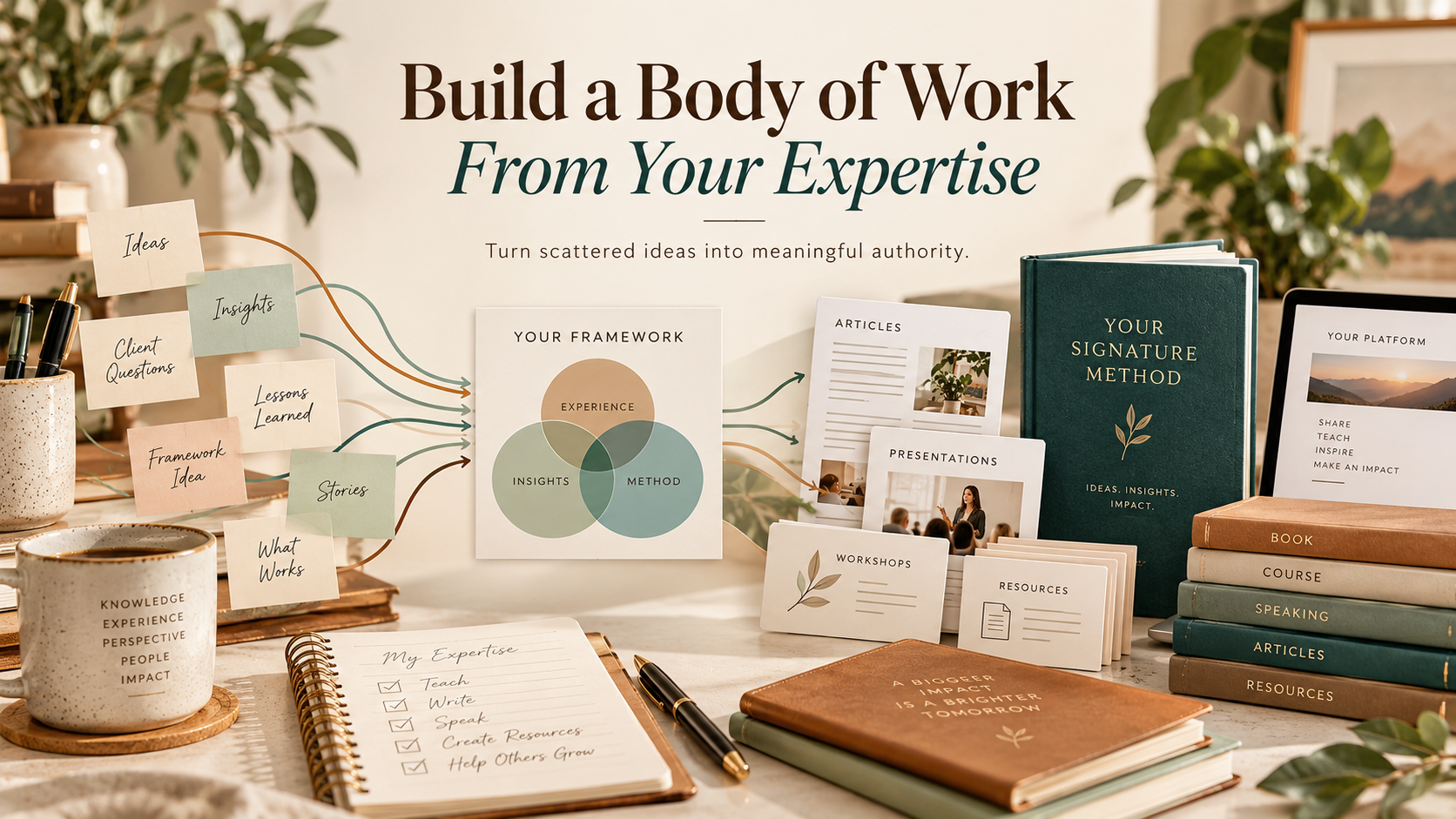
That is the difference between having content and having a body of work.
What Is a Body of Work?
A body of work is the connected collection of ideas, frameworks, stories, methodologies, books, teaching, and authority assets that represent what you know and what you stand for.
It is not simply everything you have ever created.
A body of work has a center.
There is an idea, belief, problem, or transformation connecting the pieces.
Your articles support it.
Your presentations explain it.
Your book explores it in depth.
Your framework gives it structure.
Your stories bring it to life.
Your services help people apply it.
Over time, people begin recognizing the connection.
They no longer simply remember that you produce useful content.
They remember what you are known for.
That is where authority begins becoming something lasting.
Content Is Something You Publish. A Body of Work Is Something You Build.
This distinction matters.
Content tends to begin with the question:
What should I post this week?
A body of work begins with:
What am I building?
Those questions lead in completely different directions.
When you are focused only on content, every week can feel like starting over.
What should I write?
What should I post?
What should I say on LinkedIn?
What newsletter topic haven't I used yet?
What does the algorithm want from me this morning?
That is exhausting.
But when you are building a body of work, your content begins coming from something larger.
Instead of inventing ideas constantly, you explore different parts of your central thinking.
One concept can become:
- An article
- A newsletter
- A podcast conversation
- A video
- A chapter
- A workshop
- A keynote
- A client exercise
Suddenly, content is no longer the work.
It is one way you share the work.
Why Experienced Experts Often Have Fragmented Expertise
When you have been doing something for twenty or thirty years, you accumulate knowledge gradually.
You do not wake up one morning with a complete intellectual property portfolio.
You learn something from a client.
Then something from a mistake.
Then something from a project that worked remarkably well.
Then something from one that absolutely did not.
You teach a workshop.
You create a process.
You answer the same question fifty times.
You notice a pattern.
You develop an opinion.
Eventually, you know a great deal.
But because that knowledge arrived over years, it often remains fragmented.
You understand it intuitively.
Other people do not.
That is why one of the most important jobs of an experienced expert is to step back and ask:
What connects what I know?
That question is the beginning of authority architecture.
Start With the Idea You Want to Be Known For
Before deciding what to build, clarify what you want all of it to point toward.
Ask yourself:
If someone encounters my work five years from now, what do I want them to associate with my name?
Not your job title.
Not every service you offer.
The idea.
For me, much of my current work comes back to this belief:
Your experience has value, and someone else may need what you have learned.
From that belief come other ideas:
Your expertise should not remain hidden.
Authority begins when you recognize the value of what you know.
A framework can give your expertise structure.
A book can give your ideas permanence.
Thought leadership turns experience into contribution.
Authority is earned through generosity.
One central belief can support an entire body of work.
That is very different from creating random content about whatever happens to be trending this week.
Find the Intellectual Property Already Hiding in Your Experience
Your body of work does not begin with what you want to create.
It begins with what you have already learned.
Look for the intellectual property embedded inside your experience.
That may include:
- Processes you use repeatedly
- Questions you always ask
- Mistakes you know how to spot
- Stories that illustrate important lessons
- Distinctions you make that others may not
- Language you use with clients
- Principles you consistently teach
- Beliefs you have developed
- Frameworks you have informally used for years
- Problems people regularly ask you to solve
A useful question is:
What do I know now that took me ten, twenty, or thirty years to learn?
Then ask:
How could I make that knowledge easier for someone else to understand and use?
That is how experience begins becoming intellectual property.
Create the Framework That Holds the Thinking Together
One of the most powerful ways to organize expertise is through a signature framework.
A signature framework is not simply a clever set of steps.
It is a structure that explains how transformation happens.
It helps people understand:
Where they are.
Why they are stuck.
What needs to change.
What happens next.
Where the process leads.
For example, the Authority Architect Framework™ is:
See → Believe → Clarify → Build → Share → Inspire → Multiply
That framework gives my work architecture.
It helps organize everything from:
The Hidden Gifts Quiz.
The Authority Architecture™ Blueprint.
Articles.
Presentations.
Authority books.
Workshops.
Speaking.
Consulting.
The framework is not merely another piece of content.
It is the structure that helps the content belong together.
If you have not yet created your own methodology, start with my article How to Create a Signature Framework From Your Expertise.
Your framework may already exist.
You may simply need to see it.
Choose a Cornerstone Authority Asset
Once the central idea and framework become clearer, decide which asset deserves to hold the deepest expression of your thinking.
That may be:
- A nonfiction book
- A signature keynote
- A workshop
- A research report
- A comprehensive guide
- An assessment
- A course
- A consulting methodology
- A flagship presentation
I call this a cornerstone authority asset.
It becomes one of the primary ways someone can experience your body of work.
For many experts, that asset is a book.
A book provides enough space to explain:
Your point of view.
Your framework.
Your stories.
Your evidence.
Your methodology.
Your reader's transformation.
But the important thing is not simply choosing the asset.
It is making sure the asset comes from the same central body of thinking.
Otherwise, you simply have another product.
Build Around One Idea Instead of Inventing New Ones Constantly
Imagine you have a central idea and signature framework.
That one piece of intellectual property can generate an enormous amount of meaningful work.
For example:
Core Idea
↓
Signature Framework
↓
Authority Book
↓
Keynote Presentation
↓
Workshop
↓
Assessment
↓
Newsletter Series
↓
Articles and Videos
↓
Consulting Program
Notice what is happening.
You are not creating nine unrelated things.
You are exploring one meaningful body of thinking in nine useful formats.
That creates consistency.
It also creates recognition.
Someone may first discover you through an article.
Then hear you on a podcast.
Then attend a presentation.
Then read your book.
Then hire you.
Each experience reinforces the others.
That is how authority compounds.
Thought Leadership Is the Conversation Around Your Body of Work
Thought leadership is often misunderstood as content creation.
Post frequently.
Comment on trends.
Build an audience.
Share opinions.
Those things may contribute to visibility.
But thought leadership is something deeper.
Thought leadership is what happens when you bring your experience, ideas, and point of view into a larger conversation in a way that helps people think differently.
Your body of work is what you are building.
Thought leadership is how you contribute that work to the world.
That is why thought leadership becomes much easier when you have a clear body of work.
You no longer need to wonder:
What should I say?
You have something to say.
The work is deciding which part of it is most useful right now.
Visibility Comes After Clarity
Many experts begin with visibility.
They ask:
How do I get more followers?
How do I become more visible?
Should I post more?
Should I start a podcast?
Should I create video?
Should I be on LinkedIn, YouTube, Substack, Instagram, and whatever appeared last Tuesday?
But visibility without clarity simply helps more people become confused about what you do.
A better question is:
When someone finds me, what do I want them to discover?
That changes the conversation.
Visibility is not the goal.
Findability is not even the final goal.
The goal is for the right people to find something meaningful when they arrive.
That requires a body of work.
A Body of Work Makes Content Easier
There is another practical advantage.
Building a body of work dramatically reduces the pressure of content creation.
Let's say your framework has seven stages.
Each stage contains:
Three common problems.
Three beliefs that need to change.
Three stories.
Three exercises.
Three client questions.
Three mistakes.
That alone gives you more than one hundred potential content ideas.
And they all connect.
You are no longer trying to invent an entirely new identity every week.
You are deepening the conversation around the expertise you have already chosen to own.
That consistency is not boring.
It is how people begin remembering what you stand for.
Your Body of Work Should Have a Point of View
A collection of information is not enough.
A body of work should reveal how you think.
For example, I believe:
Authority begins before visibility.
Your experience may become someone else's breakthrough.
Expertise becomes more valuable when it becomes useful.
A book should organize intellectual property, not simply fill pages.
AI can accelerate the expression of expertise, but it cannot manufacture earned authority.
Those beliefs create coherence.
They tell someone:
This is how Donna sees the world.
Your body of work should do the same.
Ask:
What do I believe because my experience taught me to believe it?
That may be one of the most important questions you answer.
The Authority Architect Framework™ Is a Body-of-Work Framework
This is also why the seven stages of the Authority Architect Framework™ fit naturally into this conversation.
See
Recognize the value of the experience, stories, knowledge, and lessons you already carry.
A body of work begins with awareness.
Believe
Accept that your experience may be useful to someone else.
You cannot build authority around knowledge you are still apologizing for having.
Clarify
Identify the problem, audience, point of view, and idea you want to become known for.
This gives your body of work a center.
Build
Turn that thinking into intellectual property.
Create the framework.
The book.
The methodology.
The assessment.
The authority asset.
Share
Put the ideas where the people who need them can discover them.
Articles.
Speaking.
Podcasts.
Newsletters.
Video.
Teaching.
Inspire
Help people use the ideas to create meaningful change.
The goal is not merely information.
It is transformation.
Multiply
Allow the body of work to extend beyond your direct presence.
A book becomes a keynote.
A framework becomes a workshop.
A workshop becomes a program.
A methodology becomes a community.
An idea becomes a legacy.
That is what multiplication looks like.
Do Not Confuse More With Better
There is a temptation when building authority to keep adding.
Another course.
Another lead magnet.
Another program.
Another social platform.
Another podcast.
Another book.
Sometimes the most powerful move is the opposite.
Remove what does not support the central idea.
Ask:
Does this deepen the body of work?
Does it help someone discover the body of work?
Does it help someone apply the body of work?
If the answer is no, perhaps it does not belong.
A strong body of work is not defined by quantity.
It is defined by coherence.
Your Book Should Belong to the Larger Architecture
This is especially important if you are thinking about writing a book.
Do not write a book simply because authorship sounds impressive.
Ask:
What role will this book play in my larger body of work?
Will it:
Define your methodology?
Introduce your signature framework?
Support speaking?
Create a foundation for a program?
Build trust before a consulting conversation?
Preserve knowledge you want to pass forward?
Become the central text behind a community?
The answer determines the book you should write.
Your book should not sit alone on a digital shelf waving hopefully at strangers.
It should belong to something larger.
AI Makes a Body of Work Even More Important
AI is making content easier to create.
That means simply producing more content becomes less distinctive.
Anyone can generate an article.
Anyone can generate fifty social posts.
Anyone can create a generic book outline in seconds.
What AI cannot manufacture is the coherence that comes from decades of earned experience and a distinct point of view.
That is why I believe experienced experts should spend less time asking:
What can AI create for me?
And more time asking:
What do I have that AI can help me express?
Your body of work is the answer to that question.
AI can help organize it.
Accelerate it.
Repurpose it.
Explore it.
But the substance should still come from you.
How Do You Know If You Have a Body of Work?
Ask yourself these questions:
Can I identify the central idea I want to be known for?
Do my articles, presentations, and offers reinforce that idea?
Do I have a named framework or methodology?
Can people explain my approach after encountering my work?
Does my content build on previous ideas rather than constantly starting over?
Could one authority asset naturally lead to another?
Do I have a point of view that appears consistently across my work?
If your answers are mostly yes, you are probably building a body of work.
If they are mostly no, you may have a collection of good ideas.
That is not a failure.
It is raw material.
Now it needs architecture.
Your Next Inspired Action
Take a blank sheet of paper and write this question in the center:
What do I want to be known for?
Then surround it with everything you already have related to that idea:
Books.
Articles.
Presentations.
Processes.
Stories.
Frameworks.
Tools.
Client questions.
Workshops.
Podcasts.
Assessments.
Programs.
Do not organize them yet.
Just look.
You may discover something important.
The body of work may already be there.
You simply have not seen the architecture connecting it.
See the Full Authority Architect Framework™ Live
If you are beginning to recognize that you have valuable experience but need a clearer way to organize, build, and share it, I would love to invite you to my next free live presentation.
During The Authority Architect Framework™ presentation, I'll walk you through the seven stages:
See. Believe. Clarify. Build. Share. Inspire. Multiply.
You'll see how your experience can become a clear body of work—and how that body of work can build trust, create opportunities, inspire others, and extend your impact.
Most importantly, you will leave with a better understanding of where you are in the journey and what your next step should be.
Your expertise has already been earned.
Now let's give it the architecture it deserves.
Reserve Your Free Seat for the Live Authority Architect Presentation
Because the question is no longer:
What should I create next?
It is: