
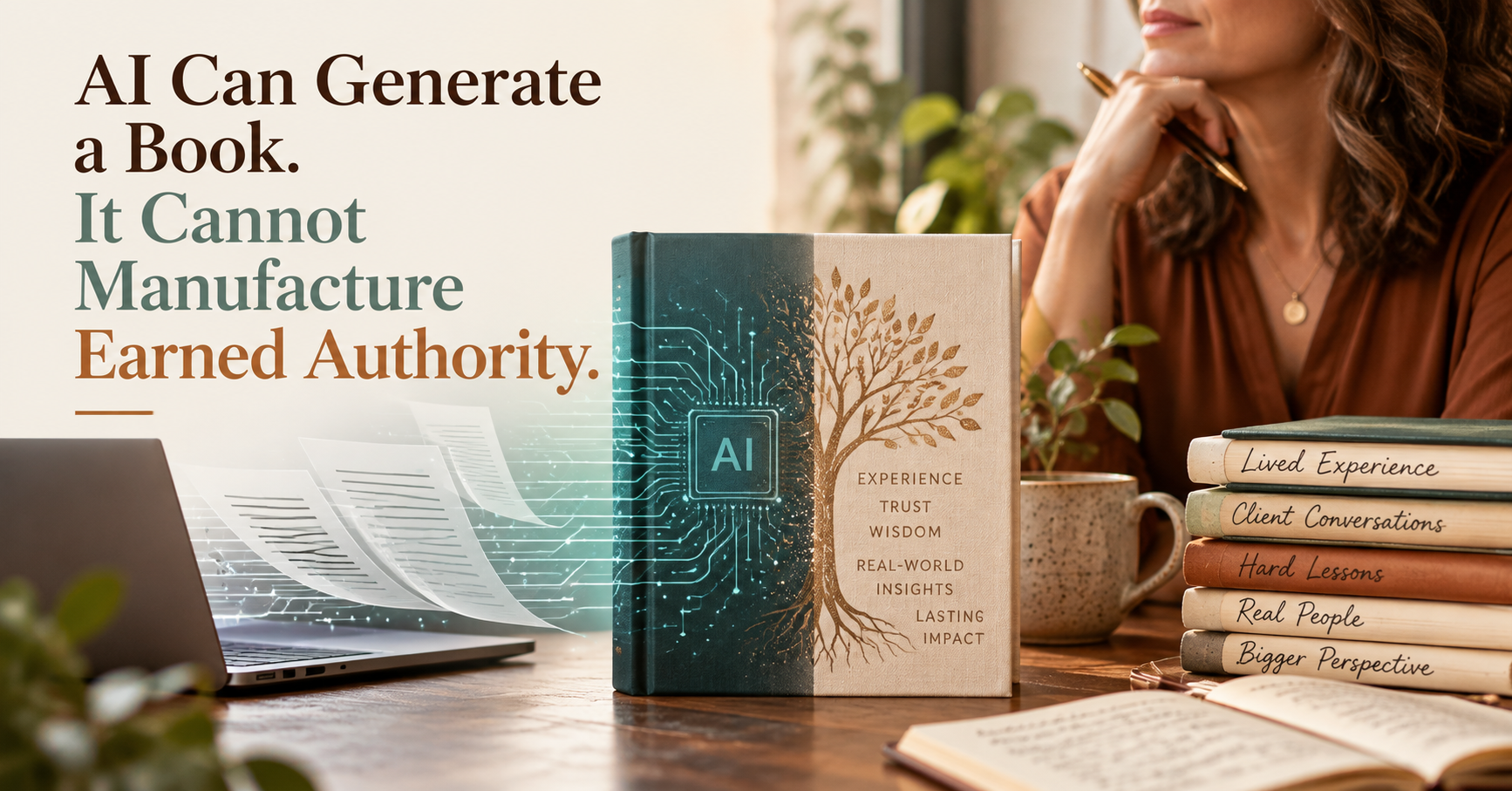
A few years ago, writing a book was difficult largely because producing 40,000 or 50,000 words required a tremendous amount of time.
That obstacle is disappearing.
Generative AI can now produce book-length text at extraordinary speed. Amazon even distinguishes between AI-generated content, which publishers must disclose to KDP, and AI-assisted content, where the author creates the content and uses AI to edit, refine, brainstorm, or improve it. Kindle Direct Publishing
So perhaps the question is no longer:
Can AI help you write a book?
Of course it can.
The more important question is:
Will the book prove that you actually have something worth saying?
Because those are not the same thing.
AI can produce words.
It can suggest chapter titles.
It can reorganize transcripts.
It can summarize research.
It can improve sentences.
It can help you move faster.
What it cannot do is manufacture the twenty or thirty years of experience that taught you what matters.
It cannot retroactively create the client conversations that changed your thinking.
It cannot give you judgment you have not earned.
It cannot invent a methodology you have actually tested.
It cannot create genuine stories of failure, reinvention, discovery, or success.
And it cannot manufacture earned authority.
That difference is becoming more important by the day.
We Are Entering an Era of Abundant Books
Recent research gives us a glimpse of what happens when book production becomes dramatically easier.
A 2026 working paper examined 14,419 self-published genre-fiction books sold on Amazon between 2023 and 2026, matched with daily sales data through June 2026. Researchers found that books containing substantial detected AI text—more than 25% of the manuscript—made up a significant portion of the catalog and were gaining sales share over time. SSRN
One number is particularly revealing.
During the study period, the number of books with observed quarterly sales increased 19.2-fold, while quarterly revenue increased only 8.9-fold. In other words, the number of selling books grew much faster than the money available to those books. Revenue per selling title declined across most of the genres studied. PREreview
Another 2026 NBER working paper found that monthly book releases roughly tripled from 2022 through late 2025 as large language models spread. It also reported deterioration in average usage measures such as sales rank and ratings as the number of books increased. National Bureau of Economic Research
An important caveat: these studies largely examine self-published genre fiction, not the nonfiction authority books I help experts create.
I would not pretend the findings prove exactly what will happen in business nonfiction.
But they reveal an important market dynamic:
When the cost of creating something approaches zero, simply creating it becomes less distinctive.
That is the part experts need to pay attention to.
Publishing a book is becoming easier.
Publishing a book that demonstrates genuine authority is becoming harder—and more valuable.
The Book Was Never the Authority
This is where I believe we have confused the outcome with the vehicle.
For years, we have heard:
“Write a book and become an authority.”
I would turn that around.
A book does not make you an expert. It gives your expertise somewhere to live.
The authority should exist before the manuscript.
It exists in:
- The problems you have repeatedly solved
- The patterns you have learned to recognize
- The mistakes you can now predict
- The questions you know to ask
- The results you have helped create
- The beliefs you have developed through experience
- The stories only you can tell
- The methodology you have refined
- The judgment you bring to situations where there is no obvious answer
Those things are the raw material.
The book gives them architecture.
AI may help build that architecture faster.
But it cannot supply the raw material if you do not have it.
Generic Information Is Becoming Cheap
Ask an AI system for:
“Ten leadership tips.”
“Five ways to market a consulting business.”
“Seven habits of successful entrepreneurs.”
You will have an answer before your coffee cools.
That changes what readers need from experts.
Information alone is becoming abundant.
What remains scarce is earned perspective.
Consider the difference between these two statements:
Successful leaders communicate clearly.
and:
After working with leadership teams for twenty-five years, I have noticed that communication usually breaks down one decision before people realize it has. Here is the pattern I look for.
The first statement may be perfectly true.
The second contains something else.
Experience.
Pattern recognition.
Judgment.
A point of view.
That is the beginning of authority.
AI Cannot Live Your Story
Some of the most important material in an authority book does not come from research.
It comes from living.
The client who forced you to reconsider your process.
The business decision that cost you dearly.
The mistake you made twice before you recognized the pattern.
The mentor who said one sentence you remembered for twenty years.
The strategy everyone told you would work that failed spectacularly.
The moment you realized the problem you had been solving was not actually the real problem.
AI can help you tell those stories more clearly.
It cannot have them for you.
That distinction matters because readers do not simply want conclusions.
They want to understand how you came to know what you know.
That is what gives ideas credibility.
AI Cannot Earn Your Judgment
Expertise is not simply access to information.
It is knowing what matters.
Imagine two people with access to exactly the same facts.
One has spent thirty years working in the field.
The other began yesterday.
They may possess the same information.
They do not possess the same judgment.
The experienced professional knows:
When the textbook answer will probably fail.
Which variable matters most.
What question everyone forgot to ask.
What warning sign deserves attention.
When to follow the process.
And when experience says the process needs to be adapted.
That judgment was purchased with time.
AI can analyze patterns in existing information.
But your authority comes partly from the patterns you learned to see through doing the work.
AI Cannot Manufacture a Proven Methodology
This is also why I believe signature frameworks will become even more important.
A genuine framework is not simply:
“Give me a catchy five-step acronym about leadership.”
Yes, AI can produce one.
Probably twelve of them.
Some of them may even rhyme, heaven help us.
But a signature framework should come from something deeper.
It should reflect:
- Problems you have encountered repeatedly
- A sequence you have learned matters
- Decisions you make consistently
- Principles you have tested
- Mistakes you help people avoid
- A transformation you understand
- Your distinct point of view
Your framework is the architecture of your thinking.
That is intellectual property worth building.
If you have not yet identified yours, start with my article How to Create a Signature Framework From Your Expertise.
The goal is not to invent a clever framework.
It is to uncover the framework already hiding inside your experience.
This Is Where the Authority Architect Framework™ Begins
When I developed the Authority Architect Framework™, I deliberately did not begin with writing.
The framework is:
See → Believe → Clarify → Build → Share → Inspire → Multiply
AI enters much later in that journey than most people think.
See
First, you must recognize the experience, lessons, stories, and patterns you have accumulated.
AI cannot decide which parts of your life and work matter most.
Believe
You have to believe that what you know can help someone else.
No prompt can give you permission to contribute.
Clarify
You determine what you want to become known for, who needs the message, and what you believe about the problem.
This is where thought leadership begins.
Build
Now technology becomes tremendously useful.
AI can help:
- Transcribe conversations
- Organize notes
- Analyze existing content
- Identify repetition
- Suggest structures
- Help develop outlines
- Improve readability
- Ask questions that uncover missing material
This is exactly how I believe AI should be used.
Your wisdom is the source. Technology is the assistant.
Share
AI can help transform the central body of work into articles, emails, podcast ideas, presentations, social content, and supporting materials.
Inspire
But the work must still mean something to another human being.
Information is not transformation.
Multiply
Finally, the intellectual property can expand into books, keynotes, workshops, courses, programs, communities, or other assets.
That is very different from asking AI to “write me a book about leadership.”
Start With the Authority Skeleton, Not Chapter One
One of the biggest mistakes I see aspiring authors make is opening a blank document and beginning Chapter One.
They write.
Restart.
Change direction.
Rewrite.
Discover halfway through that the book is actually about something different.
Then start again.
The problem was not writing ability.
They skipped the architecture.
Before generating prose, build what I call the Authority Skeleton.
Map:
The reader
Who is this book actually for?
The problem
What are they trying to understand or solve?
Your point of view
What do you believe about this problem?
The transformation
Where should the reader be by the end?
Your framework
What methodology creates that transformation?
Your evidence
What stories, client experiences, results, examples, and observations support it?
The reader journey
What must they understand first, second, third, and next?
Then write.
AI can make the writing process dramatically faster once that thinking exists.
Without it, AI simply helps you produce generic material faster.
Speeding up the wrong process is not much of a breakthrough.
What Should an Authority Book Contain That AI Cannot Fake?
If you are creating a book to establish genuine authority, I would look for at least these elements.
1. A Distinct Point of View
What do you believe because your experience taught you to believe it?
2. A Signature Framework
How have you organized your understanding of the problem into a methodology someone else can apply?
3. Firsthand Stories
What happened to you, your clients, your business, or your career that shaped your thinking?
4. Original Observations
What patterns have you seen repeatedly that someone outside your work may miss?
5. Documented Results
Where appropriate, what evidence demonstrates that your approach creates meaningful outcomes?
6. Useful Tools
Assessments, questions, exercises, checklists, decision frameworks, or other resources that help the reader act.
7. A Recognizable Voice
The reader should feel there is a particular human being behind the ideas.
8. A Meaningful Next Step
What do you want the reader to understand, believe, or do because they encountered your work?
These are the ingredients that turn a manuscript into a body of work.
The Future May Favor Experts Who Have Actually Done Something
There is an irony in all of this.
The rise of AI may make human expertise more valuable, not less.
When anyone can generate competent information, we begin asking different questions:
Who has actually done this?
Whose judgment do I trust?
Where did this methodology come from?
What evidence supports it?
Does this person have a distinctive perspective?
Can they help me apply this in the messy reality where generic advice stops working?
The answer will not be found in how many words someone can produce.
AI has already won that competition.
The advantage moves somewhere else.
Toward experience.
Judgment.
Trust.
Original thinking.
Usefulness.
Contribution.
Do Not Compete With AI on Volume
If AI can help someone publish five mediocre books in the time it takes you to create one meaningful book, do not compete by trying to publish six.
That race has a depressing finish line.
Instead, ask:
What can I create that could only credibly come from me?
What have you earned the right to teach?
What experience changed how you see the problem?
What framework have you developed?
What belief are you willing to stand behind?
What story demonstrates why the work matters?
What can your reader use tomorrow?
Those questions lead somewhere much more valuable than “How quickly can I generate 50,000 words?”
They lead toward a body of work.
AI Should Accelerate Authority, Not Substitute for It
I am not anti-AI.
Quite the opposite.
I believe AI can be one of the most useful tools experienced experts have ever been given.
It can help us capture knowledge that might otherwise disappear.
It can help someone who struggles with writing finally express decades of experience.
It can organize hundreds of scattered notes.
It can surface themes across presentations, interviews, articles, and transcripts.
It can dramatically shorten the distance between idea and execution.
But there is a line worth protecting.
Use AI to accelerate the expression of your expertise. Do not ask it to manufacture expertise you haven't earned.
Those are very different uses of the technology.
One amplifies a human body of work.
The other manufactures more content.
And we already have plenty of content.
Your Book Is Not the Product of a Prompt
Your authority book should be the product of a life, a career, a point of view, a methodology, and a contribution.
AI can help you turn all of that into words.
Wonderful.
Let it.
But begin with what no machine can supply:
What you have lived.
What you have learned.
What you believe.
What you have proven.
What you see differently because you have been there.
That is earned authority.
And in a world where generating a book is becoming easier every day, earned authority may be the most valuable thing your book contains.
Your Next Inspired Action
Before you ask AI to outline your book, answer these five questions yourself:
What have I learned through experience that I could not have learned from a prompt?
What problem have I solved enough times to recognize patterns?
What do I believe about that problem that shapes my approach?
What framework or methodology has emerged from doing the work?
What could someone do differently because I chose to share it?
Start there.
Then invite AI into the room.
Not as the expert.
As the assistant.
Before You Write the Book, Find the Authority Behind It
The Authority Architecture™ Blueprint can help you identify the expertise, point of view, framework, and body of work your book should be built around.
Because the question is no longer whether technology can generate your manuscript.
The question is whether the manuscript contains something worth attributing to you.
Get the Authority Architecture™ Blueprint →Or join the next live presentation.